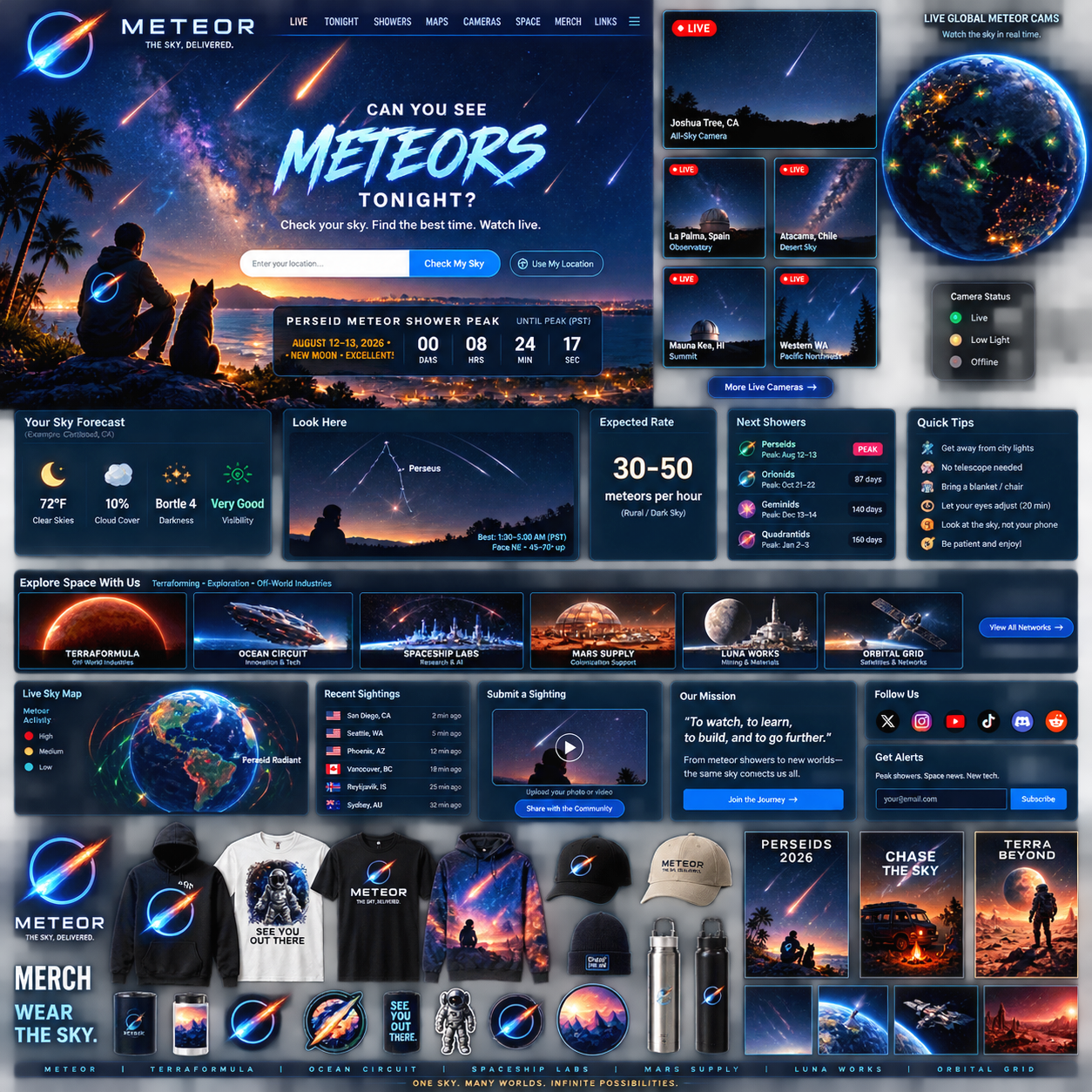
PERSEIDS 2026 · ACTIVE NOW

CAN YOU SEE METEORS TONIGHT?

Check your local cloud cover, see the 2026 Perseid peak in your own time zone, watch real sky cameras, and find the best hours to step outside.

● Live sky cameras
ShowerPerseids
MoonNew Moon
RadiantPerseus / NE
Rural rate30–50/hr*
DISPLAY AD · set CONFIG.adsenseClientId + adSlots.heroBanner to enable
Live local forecast

Is your sky worth watching tonight?

Use your device location or search a city/ZIP. Meteor.Watch scores the upcoming night using cloud cover, precipitation probability and visibility.

Location

Check the sky

Location is requested only after you click. Coordinates are sent directly from your browser to Open-Meteo for the forecast; Meteor.Watch has no location backend in this static build.

Enter a city or use your location to load tonight’s forecast.
Tonight score
Waiting for location
Upcoming viewing window
Cloudsnight avg
Visibilitynight avg
Rain chancenight avg
Nowweather
Hourly forecast will appear here.
Weather/geocoding data: Open-Meteo. Forecasts are model guidance, not a guarantee of clear sky. Use an Open-Meteo plan/license appropriate to the site’s production and commercial traffic.
Live sky

Watch the sky in real time.

Real observatory camera sources give Meteor.Watch something more useful than a generic article: a place to actually watch the night.

Live video is provided by external observatories. If an individual YouTube stream is ever rotated, use the official live hub. Open current live hub ↗
● LIVE · OFFICIAL STARCAM

Maunakea · West

CFHT–Asahi StarCam looking west from Maunakea. CFHT describes this camera as a 4K 24/7 StarCam designed to capture night-sky events including meteor showers.

● LIVE · OFFICIAL STARCAM

Maunakea · East

Subaru–Asahi StarCam looking east from the Subaru Telescope on Maunakea. The official StarCam has continuously monitored the sky for meteor activity and other transient events.

Subaru Telescope summit cameras

Current Maunakea views

Current Subaru Telescope north cameraNorth
Current Subaru Telescope northeast cameraNortheast
Current Subaru Telescope south cameraSouth
Current Subaru Telescope southeast cameraSoutheast
These observatory images update every few minutes at the source. Meteor.Watch refreshes them every 5 minutes.
DISPLAY AD · set CONFIG.adsenseClientId + adSlots.midContent to enable
2026 meteor calendar

Tonight is only the beginning.

The site rolls forward into the next major shower instead of dying when the Perseids end.

Active now
Perseids
Aug 12–13, 2026

ZHR 100 theoretical; rural observers commonly see lower real-world rates. New moon gives excellent conditions.

Next major
Orionids
Oct 21–22, 2026

Typical ZHR around 20. Moonlight is less favorable in 2026.

Late year
Geminids
Dec 13–14, 2026

Usually one of the strongest showers of the year, with a theoretical ZHR around 150.

December
Ursids
Dec 21–22, 2026

A smaller northern-hemisphere shower, typically around 5–10 meteors per hour near maximum.

Calendar data is summarized from the American Meteor Society and International Meteor Organization 2026 calendars. Exact peaks can vary and observed rates depend heavily on sky quality.
Viewing guide

Get more meteors with less gear.

Built for the search questions people actually ask: what time, where to look, what to bring and whether a telescope helps.

01 · DARK

Escape direct light

Pick a safe open location with the darkest sky available. Turn down your phone and avoid streetlights in your field of view.

Open light-pollution map ↗
02 · ADAPT

Give your eyes 20–30 minutes

Dark adaptation matters. A bright phone screen can reset the advantage you just waited for.

03 · WIDE

Skip the telescope

Meteor trails can appear across a huge area of sky. Lie back, keep a wide field of view and be patient.

04 · DIRECTION

Use Perseus as a reference

The Perseids radiate from near Perseus, generally northeast for northern observers. You do not need to stare directly at the radiant.

05 · TIME

Stay out later

At mid-northern latitudes the radiant reaches a useful elevation around 10–11 p.m. local time and improves later into the night.

06 · COMFORT

Bring the boring stuff

A reclining chair, blanket, warm layer, water and patience can matter more than expensive astronomy equipment.

Meteor.Pics

Photos, sightings & future community.

The media side is ready to become its own funnel: astrophotography, featured submissions, wallpapers, camera captures and eventually user sightings.

Meteor Watch space and merch visual direction

Visual concept / art direction for the Meteor network.

Planned media tools

Build the visual archive.

Meteor.Pics and the other `.pics` domains can later funnel into this one media system instead of fragmenting the audience.

meteor.picsmeteorshower.picsperseids.picsperseidmeteor.picsstargazer.pics
Next media upgrade:
submission form + moderation + featured photo grid + downloadable wallpapers.
Space merch

Wear the sky — beyond one shower.

The shop is intentionally broader than Perseids merch so the commercial side can keep working year-round.

CORE COLLECTION

Meteor.Watch

Logo tees, hoodies, hats, mugs and stickers built around the flagship identity.

SHOP DOMAIN RESERVED
SPACE / OFF-WORLD

Beyond Earth

Lunar, Mars, orbital infrastructure and deep-space visual lines that can cross over with the future space network.

GENERAL SPACE MERCH
LIMITED EVENT

Perseids 2026

Time-stamped poster, shirt and sticker designs for the launch event without making the entire store seasonal.

LIMITED DROP
STARGAZER

Night Sky

Evergreen astronomy and stargazing designs for people who came for the shower and stay for the sky.

FUTURE LINE
Commerce node

perseidmeteor.shop

The domain is reserved. For now the main Meteor.Watch page can carry the merch catalog and send buyers to the eventual storefront when it is built.

Future network

From tonight’s sky to off-world industry.

Meteor.Watch can become the public-facing entry point into the larger space ecosystem as those projects come online. No fake links: placeholders stay non-clickable until each site exists.

COMING ONLINE
Terraforming

TerraFormula

Long-term terraforming / off-world work. This card becomes a real outbound node when the site is deployed.

URL SLOT READY
COMING ONLINE
Infrastructure

Ocean Circuit

Infrastructure and network project in the larger ecosystem. Kept separate until its live destination is confirmed.

URL SLOT READY
RESERVED
Astronomy

Skygazer.Space

Broader astronomy / stargazing identity that can eventually carry evergreen sky content beyond meteor showers.

DOMAIN OWNED
EXPANDING
Space network

Next nodes

Future aerospace, lunar, Mars, orbital and off-world projects can slot directly into this grid without rebuilding Meteor.Watch.

NETWORK READY
Owned meteor network
meteor.watchmeteor.bestmeteor.picsmeteorshower.livemeteorshower.todaymeteorshower.cammeteorshower.picsperseid.liveperseids.watchperseids.buzzperseids.picsperseidmeteor.picsperseidmeteor.shopstargazer.buzzstargazer.picsskygazer.space
Search-friendly answers

Meteor shower FAQ.

Useful answers first; keyword coverage naturally follows instead of stuffing the page with repetitive phrases.

Is there a meteor shower tonight?

The Perseids are active from July 17 through August 24, 2026. Their traditional maximum occurs around August 13 UTC, so August 12 into the early hours of August 13 is the primary viewing window for much of North America.

What time is the Perseid meteor shower tonight?

The IMO gives the 2026 traditional maximum as roughly 02:00–04:00 UTC on August 13. This page automatically converts that window to your browser’s local time. At mid-northern latitudes, the radiant becomes more useful around 10–11 p.m. local time and rises higher later.

Where should I look for the Perseids?

The radiant is near Perseus, generally toward the northeast for northern observers. Meteors can streak far from the radiant, so a broad unobstructed view is better than staring at one point.

How many meteors per hour can I see?

Theoretical ZHR for the Perseids is around 100, but real observers usually see fewer. The American Meteor Society notes roughly 30–50 shower meteors per hour from rural locations near maximum under good conditions.

Do I need binoculars or a telescope?

No. Meteor showers are a naked-eye event. Optical magnification narrows your field of view and can make it harder to catch random streaks across the sky.

Why is 2026 a good Perseid year?

New moon occurs on August 12, 2026, so moonlight is minimal around the main maximum and does not wash out faint meteors the way a bright moon can.

Viewing safety: Use a legal, safe location away from traffic. Do not trespass or stop on dangerous roads just to find a darker sky.
● Cameras